The root issue: How historical data, modern legislation show the ongoing battle between wetland protection, Midwestern farmers
ST. LOUIS, Mo. (First Alert 4) - The Midwest is heavily associated with farming and agriculture, but it wasn’t always that way. Over the decades, a turn towards creating farmland in Missouri and Illinois created irreversible changes in the landscape and the presence of the things within it.
St. Louis acts as a joining ground for multiple waterways across the nation. The Missouri and Mississippi rivers merge just north of St. Louis in Hartford, Illinois, and the Ohio River merges in Cairo, Illinois. The area also hosts a slew of off-shooting streams, creeks, and floodplains from the various waterways and the consequential wetlands they create.
At one point, Missouri was crossed by various rivers, streams, and wetlands. From 1780 to 1980, the state went from an estimated 4,844,000 acres to 643,000 acres of wetlands in the state — a nearly 87% loss. In the same period, Illinois went from 8,212,000 to 1,254,000 acres of wetland in the state, an 85% loss.
In 2025, the total loss of wetlands in Missouri reached over 90%.
These floodplains and wetlands are home to unique plants and wildlife, some of which can only thrive in such areas; Decurrent False Aster is one such plant.
While wetlands and floodplains are a natural and necessary part of nature, their inherent closeness to rivers makes them a spot of envy for housing expansion and agricultural development. Agricultural development is believed to be a root cause of the depletion of wetlands, with thousands of acres being drained to become farmland.
This prompted the 1985 Swampbuster Act, a provision in the “Farm Bill” that penalized farmers growing crops on wetlands that had been converted into farmland. A study 13 years later, in 1998, estimated that the act saved about 12 million acres of agricultural wetlands.
In early 2025, the Swampbuster Act was challenged in court by an Iowa farmer. But the case was dismissed months later in May, with the challenge being ruled as having no legal standing.
In an attempt to mitigate flooding in the developed wetlands, the United States Army Corps of Engineers began to highlight and build in areas in need of flood protection. The project included building locks and dams, improving channels and creating reservoirs in the most affected areas. An update on the Army Corps plans from June 1995 shows the then-current completed and planned builds along the Mississippi, Missouri, Illinois and Kaskaskia rivers.
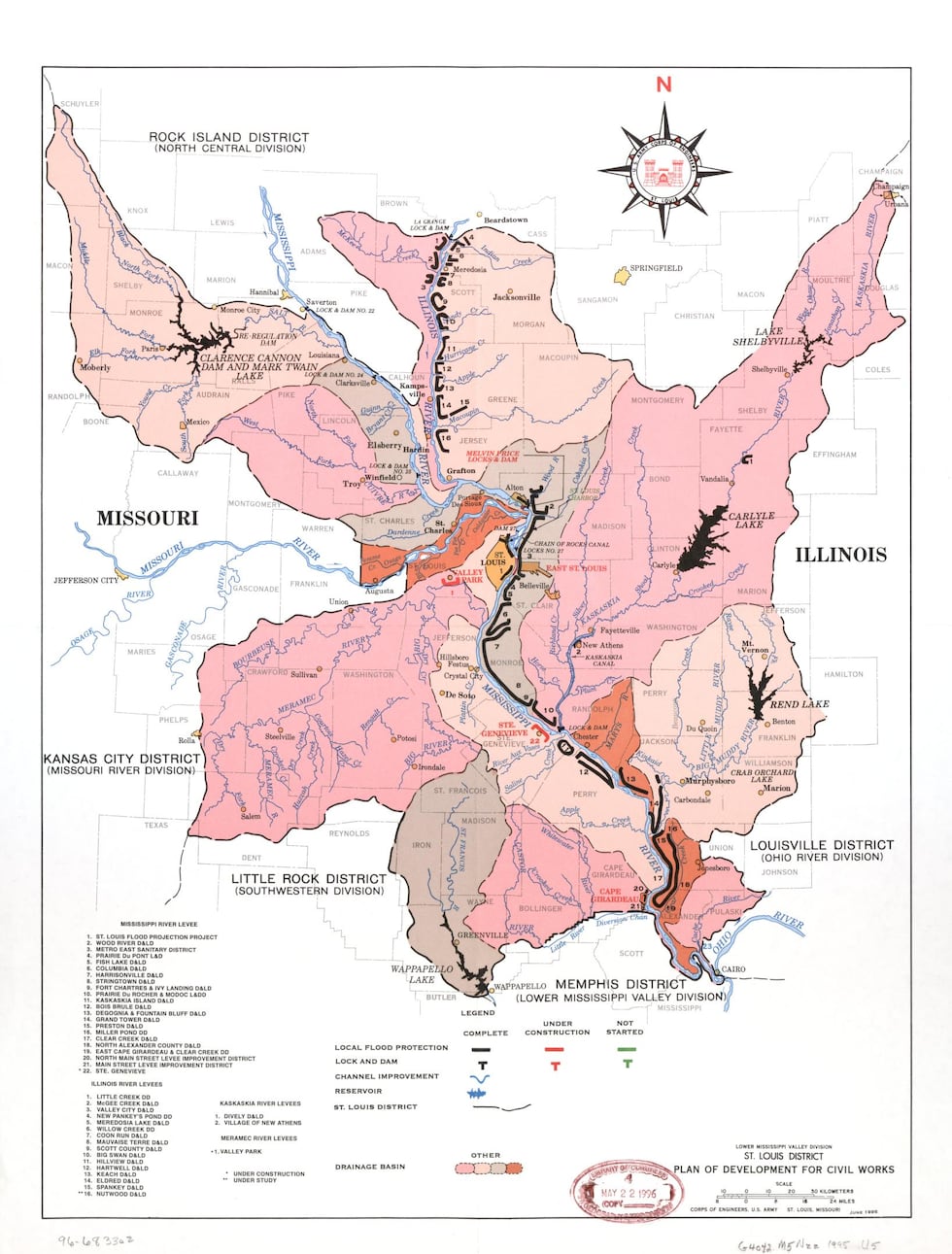
The introduction of these water mitigation systems limited persistent flooding. Still, a 1995 pamphlet on the systems notes that locks, dams and levees are not entirely preventative, such as in events like the Great Flood of ’93 or the historic flooding seen in the St. Louis area in the summer of 2022.
A 2019 report to Congress estimates that within the contiguous U.S., about 116 million acres of wetlands remain—roughly half the number of wetlands that existed in the U.S. before the 1500s.
In March 2025, the standing Environmental Protection Agency head Lee Zeldin said that the Trump administration will solve the question of which wetlands are protected, so farmers will not risk punishment for draining them. The question Zeldin mentions highlights the term “Waters of the United States,” a phrase used in the 2023 U.S Supreme Court ruling in Sackett v. EPA that declares only wetlands directly connected to a “water of the U.S.” will be protected at a federal level.
The EPA issued guidance on the new rule, but that guidance is not legally binding.
Missouri has no state-level wetland protections, with all protections stemming from the federal level. Maraias Temps Clair is currently protected, as a state designated conservation area. However, other wetlands may not have that conservation designation.
With the existent of the ruling yet to be fully understood, estimates indicate that up to 63% of the nation’s remaining acres of wetlands could lose protection.
Copyright 2025 KMOV. All rights reserved.